You Had Me At “Smaug’s Tail.”


(Update #2: I saw this again in IMAX 3D and did not enjoy it nearly as much. I’m so glad I saw this in 2D first because if I’d initially seen it in 3D I think I would have really been depressed. The tinted 3D glasses made everything seem dreary and dingy–even the stuff shot in the Shire. My eight-year-old son, however, LOVED it in 3D!)

(Update #1: Really disparate reactions to this blog and the film in general. People seem to either love The Hobbit: An Unexpected Journey, or they feel terribly disappointed. Some have even told me they think Peter Jackson has eviscerated their beloved book. Maybe you have to go into the theater expecting to hate it like I did? I keep remembering little things like the thrush cracking the snail. Anybody who has read The Hobbit will know the significance this scene has for the next film in the trilogy. It’s that kind of subtle detail that makes seeing this movie such a wonderful cinematic experience.)

I saw the movie today in the old school style—2D and 24 FPS. From the opening shot I felt like I was back in that brilliantly realized cinematic world of Middle-earth that so many of us fell in love with almost a dozen years ago. The colors, the feel, the music. It’s all the same as the first trilogy when you experience it at 24 frames per second. But I didn’t really discern the full force of the Wingnut Films movie/storytelling magic in this movie until that shot of Smaug’s fat Dragon tail snaking and flicking as it disappeared through the Gates of Erebor. I started laughing out loud. Not because I thought it was ridiculous. The total opposite. It was because it seemed so real. The little bits we saw of Smaug before this shot showed him to be a badass of monumental proportions (way scarier than the inane monsters in the preview for Pacific Rim that preceded the showing). Smaug’s tail whipping back and forth lazily, like a cat’s tail, as the Dragon sauntered into his new digs…it was just a beautiful and subtle bit of filmmaking.

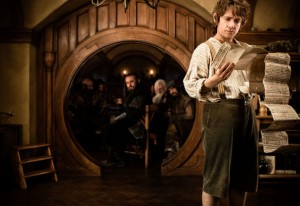
Surprisingly, this is one of the funniest movies I’ve seen in a long time. I found myself laughing out loud every couple of minutes during the first part of the film. Martin Freeman has created a character that will become a classic in film history. He is Bilbo Baggins. And I’ll even go so far as to say (and go ahead and crucify me Tolkien purists) that his Bilbo is a way more interesting protagonist than Tolkien created in his book. From Bilbo’s “Good morning” bit with Gandalf, to his interactions with the Dwarves, to his Riddles In The Dark scene with Gollum (a scene that feels like you’re watching two pro-actors in the most awesome black box theatre production of The Hobbit ever staged!), Freeman manages something most actors never accomplish: he lets us see inside his head—see his thoughts—without resorting to pulling a bunch of stupid faces. He’s incredibly subtle in this story of mercy and friendship masquerading as an action-adventure flick. The guy just blew me away. The little vocal hitch he does in his line “I’m a Baggins…(errp) of Bag End” was so perfect. One of those wee miracles of acting that I’m certain he came up with on his own during takes. My god! This guy can even act with his back to the camera! When he wakes up the morning after the Dwarf-party and he’s all alone in his Hobbit-hole, staring down the hall toward the front door facing away from us, you can feel him thinking “Oh crap, what have I done? I need to go on this adventure!” And after he catches up with the Dwarves and realizes he doesn’t have his handkerchiefs and tries to make them all go back to Bag End to get them…so perfect. In the book he merely mentions he’s forgotten them. But in the movie he’s like, “Stop! We have to go back!” Ludicrously pompous. Totally Bilbo.

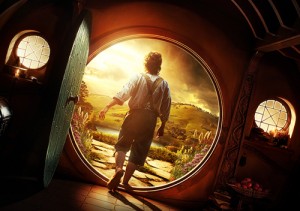
The Hobbit is a luxurious and beautiful film: the sparks floating out of the chimney at Bag End like magical fireflies, the overhead of Hobbiton as Bilbo races through yards and gardens to catch up with the Dwarves, the pine trees burning on the cliff’s edge…and that last shot of the heaps of gold in Erebor with Smaug shaking himself awake, then revealing his evil cat-like eye (which is basically how I predicted the movie would end in a blog I wrote over three months ago). And what about that scene where Thorin is striding off the felled pine tree, marching into the burning brush toward Azog? It was like a scene from the greatest opera ever staged! (Don’t you wish you could see an opera with Richard Armitage, Orcs and a Dragon? Hell, I’d go.) Should I mention the flight of the Eagles? We’ve seen this before, right? Gandalf’s rescue in The Fellowship of the Ring and Sam and Frodo lifted from the fires of Mount Doom at the end of The Return of the King. But it was way more awesome here. Spectacular. Crazy-ass-fantasy beautiful. That scene where they landed on The Carrock was perfect. And them all gazing across the Wilderlands toward Mount Doom far in the distance. I can’t wait for the next one!

By the way, I know there’s some stupid shit in this movie. Radagast’s bunny sled is simply asinine. But I didn’t care. And there were too many damned scenes with Dwarves and Bilbo on shifting ledges and Dwarves and Gandalf on shifting jerry-rigged goblin gangways and Dwarves and Bilbo and Gandalf on shifting pine trees. Enough with the 3D crap. It doesn’t need it. But still…I didn’t care.

I haven’t had this much fun at a move since…well…since my wife and I got the director’s cut for The Return of the King. And that’s what was so special about The Hobbit: An Unexpected Journey. It felt like we were treated to the director’s cut in the theater. I loved hearing the two-minute-long ode to Erebor! I loved the fact we got to see that cool flashback to the Dwarf/Orc battle! (The Battle of Azanulbizar–thanks for this factoid, Tolkien Britta!) I was amazed at how long the scene with the trolls went on. I relished every second of it. And when Gandalf appears and cracks that massive rock with his staff—splits in twain—to conveniently let the rising sun shine forth, thus turning the trolls to stone, I gasped with surprise! That’s movie magic. The writers took a scene from the book and added a clever little twist. “What if the sun were behind the rock. It’s going to be another ten minutes until it’s high enough to shine on the trolls. What would Gandalf do?” Answer: “He’d split the friggin’ rock right down the middle.” Praise to the screenwriters for this cool idea!

I have to say something about the actors. Richard Armitage turns what could have been a stuffy asshole of a character into someone deep and troubled and full of yearning. And James Nesbitt, in what might have been a throwaway roll as the Dwarf-in-the-dorky-hat, turns the raunchily-named Bofur into a sweet yet wicked guy developing a budding friendship with Bilbo. Both Armitage and Nesbitt are rangy men—both over six feet tall. It’s a testament to the skill the filmmakers have achieved with scaling the actors that they appear squat and realistically Dwarfy (yeah, I know that’s not a word) next to Gandalf and the Elves.

I have to praise Andy Serkis for creating the most stunningly realized mo-cap character in the history of film. He should win an Academy Award for best supporting actor even though he’s only on screen for about twenty minutes in this movie. When he falls over after losing the riddle contest—just collapses on his side like a worn out toddler…brilliant! That’s not special effects. That’s acting, dammit!

Oh, and Ian McKellen? He is “Ass-Kicker The Grey” in this movie. Wonderful acting aside, he just plain kicks Orc-arse. The part where he launches the blue bomb in the Goblin King’s Cave was a better weapon than anything I’ve ever seen in a video game. And then he does some serious Orc-smiting. I also loved how they have him be this sort of sheepish guy when he’s sitting across from Saruman at the White Council meeting. It’s like the writers and Peter Jackson said “Gandalf is kind of an f-up at this stage in his life. He’s the Istari who’s always getting into trouble with grumpy Saruman who admonished him for his harebrained schemes.” Gandalf is like Harry Potter trying to get the Ministry of Magic to believe Voldemort is back. It’s hilarious. “Sauron is really coming back!” “Oh, come on Gandalf, he’s dead.” “I dunno, Saruman. We should go to Dol Guldur…Morgul blade…bad feeling…” (I also liked the way Galadriel is already suspicious of Saruman here and speaks to Gandalf one-on-one with her Elven mind-meld.)

Why are critics, for the most part, ripping this film apart? I don’t get it. The production design is stupendous (John Howe and Alan Lee–you guys are masters). I was enthralled. I laughed heartily, I got numerous chills, and I left the theater with a big smile on my face. Maybe the whole 48 FPS thing really is distracting. I don’t know. But I got to go to Middle-earth again, and it was my best trip yet.

A Tolkien Bestiary Revisited

Last week I found a first edition of A Tolkien Bestiary at my local used bookstore. “Perfect Christmas present for my son,” I thought and snatched it off the shelf. I had originally bought the Bestiary when I was twelve years old (a year after it was published in 1979). It quickly became ensconced in the stack of Tolkien-themed books that I kept in a special place by my bed for late night flashlight reading—books like J.E.A. Tyler’s The Tolkien Companion (which I recently wrote about here for The Huffington Post) and Karen Wynn Fonstad’s The Atlas of Middle Earth.

Coincidentally, David Day—the author of A Tolkien Bestiary—started following me on Twitter a few days after I bought that copy of his classic. So I decided to reappraise this tome that I  (and many other Tolkien fans) have loved for over three decades.

Day’s book is a true “bestiary” and was based (as he states in his preface) “…on the Greek-Egyptian ‘Physiologus’ of the second century AD. It codified the ancients’ knowledge of magical and monstrous animals and races.” In it you’ll find entries for things like “Vampires” and “Horses”—generalized entries that do not appear in other Middle-earth dictionaries (like The Complete Guide to Middle-earth). This makes delving into the Bestiary more like reading a fascinating novel than a tedious lexicon.

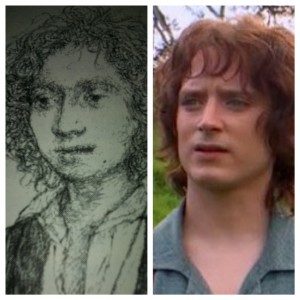
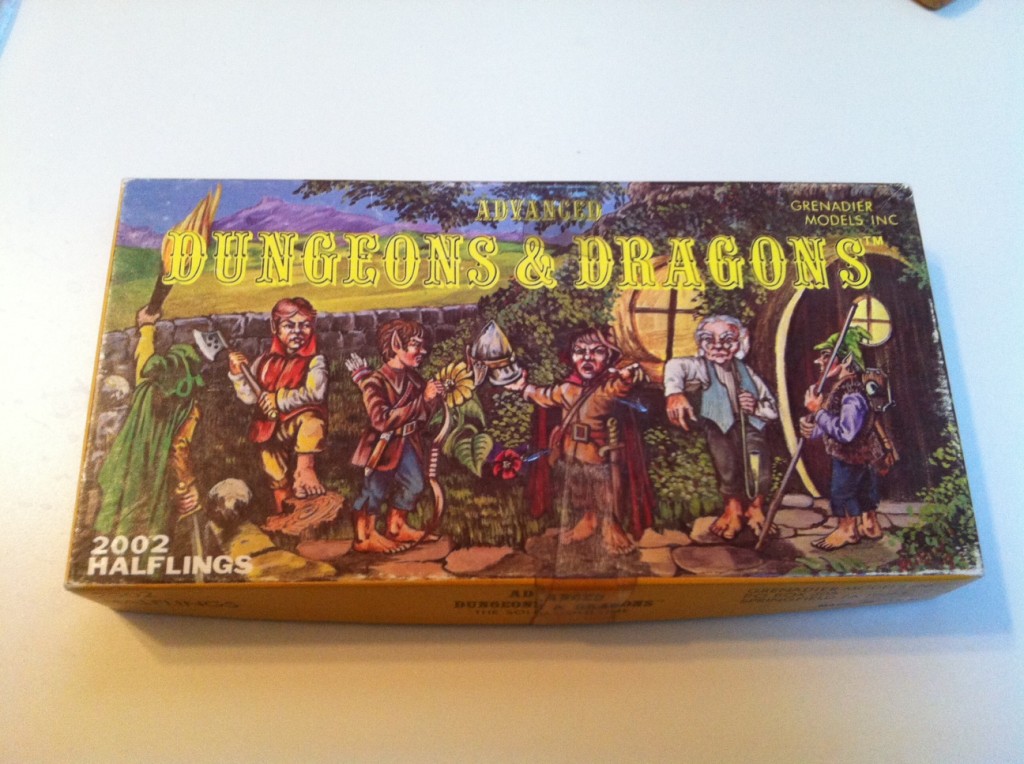
A Tolkien Bestiary is filled with stunning artwork that was created by a team of 11 artists, and these illustrations still seem fresh and interesting even after all these years. Look at how the Halfling in this image brings to mind Elijah Wood as Frodo. (Remember: the book was published two years before the actor was born!)

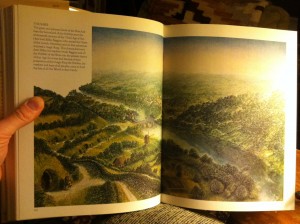
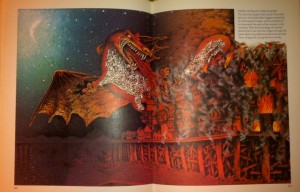
I used to pore over these paintings and drawings for countless hours, marveling at a Dürer-like line drawing of a Dunlending warrior’s wicked looking armor; or gazing at a beautiful painting of a verdant and sunny Hobbiton as seen from a soaring bird’s POV (see photo at the top of this blog); or a dynamic action scene of Smaug the Golden attacking Lake-town, the Dragon’s belly encrusted with gemstones. (Don’t be surprised if you see a shot exactly like this in The Hobbit 3.)

Day wrote the book when he was thirty years old (still a tween by Hobbit standards), but he was obviously already a Tolkien expert. You only have to read his entries on Dragons or Ents or the Noldor (wonderfully long and enlightening essays) to know that here was a Middle-earth scholar—someone capable of gleaning information from all of Tolkien’s works and consolidating the stories into highly readable yet purposefully antiquated prose.

This slightly archaic style makes you feel as though A Tolkien Bestiary could have been compiled by an inhabitant of the Shire (or even of Gondor): a companion piece to the fabled The Red Book of WestmarchA Tolkien Bestiary reads like an exciting artifact from Middle-earth.

The two charts placed at the start of the book, provided by the author for “chronological orientation” of Middle-earth, are terrific visual aids created long before the PowerPoint era. They are graphic timelines that take the events from The Silmarillion to the end of The Lord of the Rings and assemble them into coherent and easily understandable diagrams.

A Tolkien Bestiary really stands the test of time. It’s a classic in its own right and the perfect companion for Tolkien’s Middle-earth canon. I had the pleasure of corresponding with David Day via Twitter and he told me that he wrote the entire book in a coffee house that had once been the bookstore of the great Orwell. Most of us have heard the story of J.K. Rowling writing her first Harry Potter book in The Elephant House coffee shop in Edinburgh. Well, David Day beat this writerly feat by over twenty years!

Day has a new a new book called Nevermore. It’s about how the fates of animals are wholly linked to the history of humankind. Ex-Python and author Michael Palin said Nevermore is “a beautiful and timely book.” I ordered a copy and can’t wait to read it.

You can buy a copy of A Tolkien Bestiary from almost any online retailer. And if you’re lucky enough, you might find a perfect first edition at your local used bookstore.

Ronald & Rayner

“In a hole in the ground there lived a hobbit.”

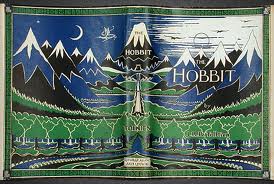
September 21st is the 75th anniversary of the publication of The Hobbit. J.R.R. Tolkien, as the story goes, scribbled the first line of his now famous book while taking a much-needed pause from grading English papers. The words came to him in a flash of insight—an epiphany that would change literature forever and create a whole new genre of serious fantasy, leaving behind “the gimcrack of conventional modern fairy-tales” that Tolkien so despised (think early Disney films).

But The Hobbit would never have been published if not for the recommendation of a ten-year-old. Rayner Unwin, son of the publisher Stanley Unwin, was handed a manuscript of The Hobbit by his father and paid a shilling to write a report on it (one shilling was decent pocket-change for a kid back in the 30’s). Rayner enjoyed Tolkien’s book and wrote, “…it is good and should appeal to all children between the ages of 5 and 9.” And that was enough for his father. It is one of the great ironies of publishing history that an Oxford professor’s book was given the go-ahead based simply upon the vanilla recommendation of a schoolboy.

In 1937 Hitler was on the rise in Europe. The Japanese invaded China. The Spanish Civil War raged. The inaugural NFL game was played. Charlie Chaplain’s first “talkie” motion picture came out in theaters. And The Hobbit was printed with an initial run of just 1,500 copies—predating the release of Disney’s Snow White (a film with seven whistling “Dwarfs” as opposed to thirteen ferocious “Dwarves”) by exactly three months.

The next year Tolkien started work on his unnamed “sequel” to The Hobbit. He sent the first chapter to his publisher who, of course, passed “A Long-expected Party” to none other than young Rayner who was now eleven. The publisher-in-training enjoyed the chapter but complained there was too much “hobbit-talk.” Ha!

Nearly fifteen years went by. Tolkien worked diligently on The Lord of the Rings all that time, typing out the entire 600,000 word manuscript by himself. Twice. He found a publisher, and then became furious when the publisher kept stalling on the release date, and he withdrew the manuscript in a fit of pique that he soon regretted most terribly. Thankfully Rayner—now an adult and working for the family publishing company—reappeared on the scene with the good timing of a wizard, and asked if he might see the manuscript. The rest is publishing history.

Rayner shepherded Tolkien through the arduous process of getting The Lord of the Rings ready for publication. It was Rayner’s idea to divide the massive book into three parts, much to Tolkien’s annoyance (Peter Jackson is not the first to split one of Tolkien’s books into a trilogy). The author’s exchanges with Rayner (in The Letters of J.R.R. Tolkien) during this period are a wonderful and amusing window into their fascinating relationship. Tolkien is like a cantankerous but lovable Bilbo dealing with Frodo, arguing about the titles for the books (he did not like the name The Two Towers one bit), and complaining comically about finalizing the map of Middle-earth, “This map is hell!”

About a year and a half before Tolkien died he sent a letter to Rayner saying, “Everything you do for me fills me with gratitude.” He asked Rayner to please start addressing him as “Ronald”—his Christian name. This was a great honor and a mark of respect coming from someone brought up in Tolkien’s world, where even dear friends called each other by their initials: an ingrained holdover of Victorian formality. Rayner was not only Tolkien’s very old friend, he was also his literary champion and, fortunately (for all of us Tolkien fans) he had had the good sense as a ten-year-old to approve of The Hobbit. If he had not, the manuscript might have spent the last seventy-five years collecting dust, rather than living all this time in the hearts and minds of tens of millions of fans around the world.

Tolkien Throwdown Transcript: I Scour The Shire


Read transcript here

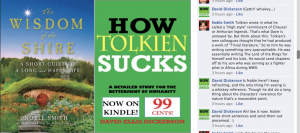
I was invited to participate in a live Facebook debate with David “wordboydave” Dickerson (author of How Tolkien Sucks). David hates The Lord of the Rings with a passion many people reserve for stinky things stuck to the bottoms of their shoes (or the loathing Gollum has for cooked food), although he admitted during our conversation that he actually loves The Hobbit.

Tolkien’s writing style, plotting, characters and use of alternate languages are anathema to David. His screed How Tolkien Sucks is actually pretty funny, but I think he’s missing a few important points about Tolkien’s conscious effort to write in a “high style” and the context in which the books were written. I made my best effort to scour him from the Shire and set him straight.

When David went off in the debate about how much he despises the long prologue to The Lord of the Rings, this was my response:

“I loved that slow entry into Middle-earth. The Lord of the Rings would never get published today. And if it did it would have to start with Ringwraiths attacking Hobbiton on the first page and burning it to the ground. Bless Professor Tolkien. An orphan at the age of 12, a survivor of the trenches of WWI, an obsessive fantasist and lover of languages who created a world that millions of people around the world have inhabited in their hearts and minds. People will still be reading his books hundreds of years from now.
”

To read the entire transcript click here (and be sure to click the “View Previous Comments” button on the Facebook page). I look forward to more debates with David, and I’m convinced one day we’ll sit around drinking beer together, reading our favorite passages of The Lord of the Rings out loud. Maybe we’ll even sing one of Tom Bombadil’s songs! Errr…maybe not.

Over a hundred people followed this debate live. Thanks for coming!


Hypothetical Hobbit Plotting (Part 2)

This series of blogs, where I make conjectures about the plot of the upcoming The Hobbit film trilogy, is purely speculative. But if you hate spoilers, read no more, because I might just stumble upon a few of them as I Hobbit-hypothesize, as well as reveal some plot and casting nuggets that have already been dropped by Peter Jackson and his crew. To read Part 1 click here.

In Tolkien’s The Hobbit, after Bilbo, Gandalf and the Dwarves arrive at Beorn’s house, the Wizard mysteriously departs for an entire day and returns at dusk, utterly famished, whereupon he slams two loaves of bread, a pound of butter and a quart of mead and practices blowing smoke rings contemplatively at the rafters. Gandalf is vague about what he’s been up to, saying he’s gone to the The Carrock, the place where the Eagles dropped them off after rescuing them from Orcs the night before. My guess is that in Peter Jackson & Co.’s version, Gandalf will have paid a visit to Rhosgobel—the home of Radagast the Brown—which Tolkien indicated lay between The Carrock and Mirkwood Forest.

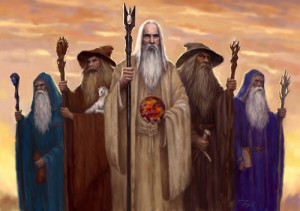
Radagast is an Istari, just like Gandalf. They are two of the five wizards who were sent to Middle-earth by the Valar (the demigods of Tolkien’s world). From the moment they were created by the Valar the angelic Istari resembled wise old men though they “aged only slowly, and they had many powers of mind and hand.” They were meant to council the inhabitants of Middle-earth (Men, Elves, Dwarves and, eventually, Hobbits) in a war against Sauron should the Dark Lord return to power. At the start of The Hobbit the five existing Istari (Gandalf the Grey, Radagast the Brown and Saruman the White as well as a pair of unnamed “blue-robed” wizards) have lived in Middle-earth for around two thousand years.

In Middle-earth Radagast’s name means “tender of beasts.” According to Tolkien’s Unfinished Tales (compiled by his son Christopher from his father’s notes) Radagast became enamored of Middle-earth’s flora and fauna and lived alone in the woods near Beorn’s homestead on the western edge of Mirkwood, forgetting his mission from the Valar to help the people of this world. He’s more like a benign Doctor Doolittle of Middle-earth than the studly Beastmaster of Mirkwood. In real life the actors who play these two wizards—Sir Ian McKellen (Gandalf) and Sylvester McCoy (Radagast)—are old friends, having most recently appeared together in a traveling stage production of King Lear with McKellen as Lear and McCoy as the Fool. It will be interesting to see if they bring shades of this production to the relationship between the dour Gandalf and the nutty Radagast.

If Peter Jackson and his writers want to make a clever visual connection to The Lord of the Rings films they could show Radagast using sentient moths as messengers, touching on the scene in The Fellowship of the Ring when Gandalf is imprisoned on the top of Orthanc, catches a moth, whispers to in a strange tongue, and then sends it off to find Gwaihir the Windlord—the giant Eagle who eventually comes to rescue him from Saruman’s lofty prison.

Close by Radagast’s home is an important site in the mythos of Middle-earth: The Gladden Fields—the place where Isildur was slain by Orcs at the start of the Third Age and where the One Ring sank to the silt in the bottom of the River Anduin. In Unfinished Tales we learn that Saruman told the White Council the One Ring was lost here and floated down the Anduin and thence into the sea. But Saruman was merely trying to throw Gandalf, Radagast and the Elves off his scent. Saruman, the craftiest of the Istari, suspects the Ring is still somewhere in the area of the Gladden Fields, and the power-hungry wizard has been searching for the all-powerful magical device for years before the action of The Hobbit begins.

What Saruman doesn’t know is that Gollum (aka Sméagol) found the Ring nearly five hundred years before and skulked off with it to the Misty Mountains where Bilbo happened upon Gollum’s “precious” after it had slipped from his finger. (Bilbo kept this wonderful treasure a secret from Gandalf.) Radagast has been living in Mirkwood almost two millennia, so he might have actually known the young Hobbit-like creature called Sméagol who used to live near the banks of the Anduin. And perhaps Radagast had heard the strange tales of the murder of Sméagol’s friend Déagol (as well as Sméagol’s sudden ability to become invisible). Radagast would certainly tell Gandalf this tale.

And maybe (still in this hypothetical film version) Radagast has found the artifact known as the Elendilmir somewhere in the Gladden Fields—a gemstone worn by Isildur and lost when he was slain by the Orcs. If Radagast did indeed find the Elendilmir, the daft wizard would probably keep the priceless artifact in an old bird’s nest or stuffed in a boot. He would show it to Gandalf—a wizard who is learned in the lore of Isildur—and Gandalf would instantly know what it was. This discovery, proof that Isildur died here, would reinforce Gandalf’s suspicions that the Dark Lord has returned to Dol Guldur to search for the One Ring in the area of the Gladden Fields.

At this point in the film Gandalf and Radagast would likely be attacked by Orcs, for Peter Jackson’s films are a wee bit action-oriented, are they not? This is the perfect opportunity for the heroic Legolas to come to the aid of the overwhelmed and outnumbered wizards. Perhaps the “young” Elf (the son of Thranduil, King of the Woodland Elves of northeastern Mirkwood) is on his way toward Dol Guldur on his own fact-finding mission in defiance of his father’s wishes. Or maybe he’s trying to find his lost love, captured by Orcs—the mysterious (and fabricated character) Tauriel played by Evangeline Lilly. Legolas and Gandalf would likely decide to partner up along with Beorn, creating a heroic trio to rival any league of superheroes: Shapeshifter, Wizard and Elven Warrior.

As an aside, I want to mention that Saruman might logically be behind an attack on Gandalf. According to Tolkien’s notes Saruman ended up with the Elendilmir gemstone and hid it in his tower of Orthanc in a secret compartment, and this would be the perfect place for him to get a hold of it. Gandalf does not suspect Saruman of treachery at this point in The Hobbit, and he doesn’t realize his fellow wizard is evil until he is made his prisoner on the top of Orthanc seventy-seven years after The Hobbit ends (see The Fellowship of the Ring, both the book and film). According to Unfinished Tales, after Aragorn becomes King, Gimli unlocks a secret chamber in Orthanc and finds two items on a shelf—a gold chain intended, no doubt, for the One Ring; and the glowing Elendilmir stone.

Gandalf returns to Beorn’s home after visiting Radagast, then leads the Dwarves and Bilbo to the western entrance to Mirkwood, leaving them to their own devices, warning them to stay on the path no matter what. (Of course they end up ignoring his sage advice.) And then Gandalf departs south for Dol Guldur with Legolas and Beorn by his side (at least in my hypothetical film version). What they find is a fortress being rebuilt and inhabited not only by Orcs, but Ringwraiths as well, including the dreaded Witch King of Angmar—Lord of the Nazgûl.

Meanwhile, Bilbo and the Dwarves make it through Mirkwood, escape from the Elven King’s realm, get to the Lonely Mountain (via Laketown) where Bilbo comes face to face with Smaug the dragon for the first time. The Hobbit: An Unexpected Journey might end with Smaug opening his evil cat-like eye, searching his dark hall for the invisible and terrified Hobbit in his midst, intercut with the cat-like Eye of Sauron opening for the first time since his downfall by Isildur’s hand, deep in the heart of Dol Guldur.

Ending the first Hobbit film at this point would be, in the action of the book, about two thirds of the way through the text. Many people might wonder, “How can Peter Jackson & Co. possibly stretch out the story for another two movies?” Get ready for the expanded role of Bard the Bowman (as played by Welsh action/throb Luke Evans) the wrath of Smaug the “Greatest of Calamities,” and Gandalf and Legolas storming Dol Guldur with a ragtag army of Elves and Men.

To be continued in Hypothetical Hobbit Plotting (Part 3)