Missing Wizards

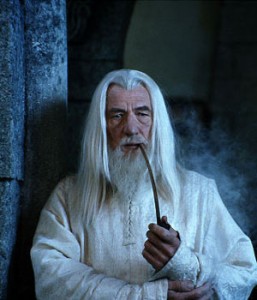
For a perfect example of Tolkien’s wildly creative genius, one needs to look no further than the Istari—his Wizards.

What were the Istari exactly? Quite simply they were angelic creatures whose souls had been deposited into corporeal vessels—bodies resembling old men. Their memories of their lives in the Blessed Realm (from whence they had come) were virtually wiped from their minds, leaving only a dim recollection of their former divine selves and life amongst the demigods called the Valar.

Even though the Istari were created as old men, they aged very slowly. When Gandalf showed up at Bilbo’s door at the start of The Hobbit, he’d been living in Middle-earth for two thousand years. (No wonder he needed that staff!) The Istari were no “conjurors of cheap tricks,” however, as Gandalf said to Bilbo in a moment of anger after Bilbo’s “eleventy-first” birthday party. They had been chosen by the Valar to come and serve the Free Peoples Middle-earth in their fight against the growing power of Sauron—the wicked servant of an even wickeder master named Morgoth (himself a fallen Vala).

The Istari were forbidden to reveal their true powers and were supposed to merely guide Men, Dwarves and Elves with good advice (and some occasional magic). And all of the Istari had been given free will to act in the ways they each thought best to achieve their mutual goal of destroying the creator of the Ring of Doom.

There were only five of these Istari in the history of Middle-earth: Gandalf the Grey, Saruman the White, Radagast the Brown and two others who are briefly mentioned but not named in The Lord of the Rings. (These two “missing” Wizards names were revealed in the posthumously published Unfinished Tales.)

Each of the Wizards reacted to their new home quite differently. Radagast became enamored of the flora and fauna of Middle-earth and eventually forgot his quest. Saruman became intoxicated by power and headed down the same crooked path as Sauron, and was eventually ensnared by the Dark Lord himself. Only Gandalf remained true to the distant memory of the Valar “a vision from afar off,” and died fighting one of Morgoth’s ancient creations—the Balrog—in the Mines of Moria. And then he was resurrected…brought back to life by the Valar and given another body (the corporeal form of Gandalf the White).

This is all visionary stuff. Spiritual beings placed into bodies manufactured by demigods, like avatars in a videogame. A main character killed off and reincarnated back into the tale—something I don’t think had ever been done in the history of literature until Tolkien’s epic. The concept of the Istari is especially inspired when one keeps in mind Tolkien conceived all of this in the middle part of the 20th century—nearly three quarters of a century ago.

In my opinion, Tolkien could have penned an entire book based on Gandalf and Saruman alone. Wizards are fascinating. Peter Jackson & Co. must have felt the same, because they’ve written both Saruman and Radagast into The Hobbit Trilogy (you can see Radagast in the film trailer being pulled in a sleigh by a gigantic bunny rabbit—a vision of inspired lunacy).

The tales of the two missing Istari would have made a great story as well. The only time a reference is made to these other two Wizards is in The Two Towers (in the chapter “The Voice of Saruman”) when, after the Ents have destroyed Isengard and trapped Saruman, the corrupted Wizard rails at Gandalf, accusing him of wanting to take control of all of Middle-earth, including seizing hold of “the rods of the Five Wizards.” Three of these “Five” Wizards are Radagast, Gandalf and Saruman himself. The other two Istari are never mentioned again, not even in the Appendices.

After Tolkien died, however, his son Christopher put together a collection of his father’s writings called Unfinished Tales that revealed selections of J.R.R. Tolkien’s notes and stories about Middle-earth that had never been published before. In the chapter concerning the Istari we learn more about these two missing Wizards. They were certainly called the “Blue Wizards” and they may have even been named Alatar and Pallando (a great subject for starting a heated debate between Tolkien geeks).

Soon after the two Blue Wizards arrived in Middle-earth they passed into the East on a mission alongside Saruman never to return. The “East” here means the distant lands of Harad (and Far Harad)—the realms populated by evil Men under the thrall of Sauron. (These are the same Men who join Sauron’s forces and attack Minas Tirith in The Return of the King.)

Did Alatar and Pallando go on a mission to study the ways of the Enemy? Were they ensnared by Sauron and become his servants, intending to do good but falling into evil? Or were they betrayed by their travelling companion Saruman out of jealousy or fear, thus starting Saruman’s downward spiral into villainy? We will never know, because Tolkien didn’t write their tale. It’s interesting to speculate, however. Perhaps Saruman killed them and absorbed their power. Or maybe they were captured and destroyed by The Dark Lord, their sprits sent flying back to the Blessed Realm. Whatever the case, by the time the events of The Lord of the Rings begin, the missing Istari are nothing more than a passing reference in Tolkien’s vast sub-creation.

Fortunately for Middle-earth there was Gandalf, the wisest Istari who never gave up hope, who always returned at the turn of the tide, the divine being sent in “human” form to help defeat Sauron and who—once his mission was accomplished—happily boarded a ship for the Blessed Realm. Before departing Middle-earth for his true home, he imparted sage advice to Merry, Sam and Pippin: “Go in peace! I will not say: do not weep: for not all tears are an evil.” This Wizard would be missed.

Tolkien Throwdown Transcript: I Scour The Shire


Read transcript here

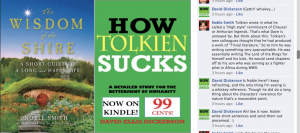
I was invited to participate in a live Facebook debate with David “wordboydave” Dickerson (author of How Tolkien Sucks). David hates The Lord of the Rings with a passion many people reserve for stinky things stuck to the bottoms of their shoes (or the loathing Gollum has for cooked food), although he admitted during our conversation that he actually loves The Hobbit.

Tolkien’s writing style, plotting, characters and use of alternate languages are anathema to David. His screed How Tolkien Sucks is actually pretty funny, but I think he’s missing a few important points about Tolkien’s conscious effort to write in a “high style” and the context in which the books were written. I made my best effort to scour him from the Shire and set him straight.

When David went off in the debate about how much he despises the long prologue to The Lord of the Rings, this was my response:

“I loved that slow entry into Middle-earth. The Lord of the Rings would never get published today. And if it did it would have to start with Ringwraiths attacking Hobbiton on the first page and burning it to the ground. Bless Professor Tolkien. An orphan at the age of 12, a survivor of the trenches of WWI, an obsessive fantasist and lover of languages who created a world that millions of people around the world have inhabited in their hearts and minds. People will still be reading his books hundreds of years from now.
”

To read the entire transcript click here (and be sure to click the “View Previous Comments” button on the Facebook page). I look forward to more debates with David, and I’m convinced one day we’ll sit around drinking beer together, reading our favorite passages of The Lord of the Rings out loud. Maybe we’ll even sing one of Tom Bombadil’s songs! Errr…maybe not.

Over a hundred people followed this debate live. Thanks for coming!


Break Bread Like A Hobbit


Are meals at your house a hasty and chaotic event? Do members of your family fight at the table? Have you ever made a meal and not been thanked for all the hard work you put into it?

If so, you and your family might want to take after the Shire-folk and break bread like a Hobbit.

Hobbits love to eat. But they especially love eating together. Meals for them are a pleasant, joyful time and they’re thankful for every meal they get, especially during those times of respite from the turmoil of their adventures.

When the Hobbits arrive at Tom Bombadil’s house after their harrowing time in the Old Forest, they’re welcomed inside and taken to a bedroom where they can wash up (just like little kids coming in from playing outside). Then they’re given a “long and merry” meal with Tom and his wife Goldberry, and are stuffed by the end of it (which is quite a difficult thing to do with a Hobbit).

When Frodo and his friends get to Bree after the terrors of the Barrow Downs and the threat of Ringwraiths on the road, they check into The Prancing Pony and are shown to a cozy little room with a cheerful fire burning on the hearth, and a table spread with a white cloth where they proceed to stuff themselves with cheese, cold meats, bread and soup. They feel “refreshed and encouraged” afterwards, which is how you should feel after a meal.

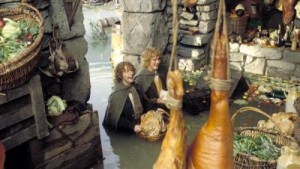
If anybody can tell me a work of fiction that mentions food and eating more than The Lord of the Rings (along with The Hobbit) please let me know. Food is, without question, one of the more important themes of Tolkien’s stories. We learn what Gandalf devours when he returns to Beorn’s house after a little jaunt (two loaves of bread smothered in butter, honey and clotted cream plus a quart of mead); what’s on the desert menu at The Prancing Pony (it’s blackberry tart); and the provisions Merry and Pippin manage to scrounge from Saruman’s storerooms (salted pork, rashers of bacon, bread with butter and honey, wine and beer).

Tolkien was, apparently, obsessed with food. He was orphaned at the age of twelve, and must have been deprived of many a home cooked meal. Then he had to live in the squalid trenches during WWI where men existed on a few ounces of stale (or rotten) food each day. By the time he was working on The Lord of the Rings, England was at war again and even tea, god forbid!, was rationed (Tolkien liked his tea with honey, by the way).

Hobbits are the original foodies. They are obsessed with mushrooms and the best beer (The Golden Perch, we are told, had a legendary ale). They make themselves sumptuous birthday party feasts, and going away part feasts, and probably even party planning feasts.

But they’ll take what they can get and they’re happy for it. They actually love the delicious and nutritious lembas, the Elven waybread given to them in Lothlórien (which is like the Middle-earth version of a Luna Bar). Merry and Pippin aren’t above scrounging through the flotsam and jetsam of Isengard for a meal (and a good smoke to boot). And Sam even brings along his own camp cooking gear including pans, a wooden spoon and a precious box of salt. He makes a stew of some rabbits (captured by Gollum) with some scrounged herbs thrown in, and this meager meal “seemed a feast.”

That’s because the Hobbits are grateful for whatever they can get, and even though they’re greedy by nature, they’re happy to share. They would never eat alone when they could eat together, talking merrily and enjoying one another’s company.

“Peaceful, Happy, Grateful.” That is what’s written in crayon over the entrance to our dining room. My son inscribed the words one day while I lifted him up so he could reach that high place. We’d decided, as a family, that those three words were really important to us when having a meal together. And we wanted to remember them every time we sat down.

Peaceful because life is hectic and meals should be a time to relax.

Happy because we’re all together.

Grateful because there are a lot of people in the world who don’t have enough to eat.

We try as best as we can to always eat as a family. And we make every meal that we’re lucky enough to share together something that nourishes our souls as well as our bodies.

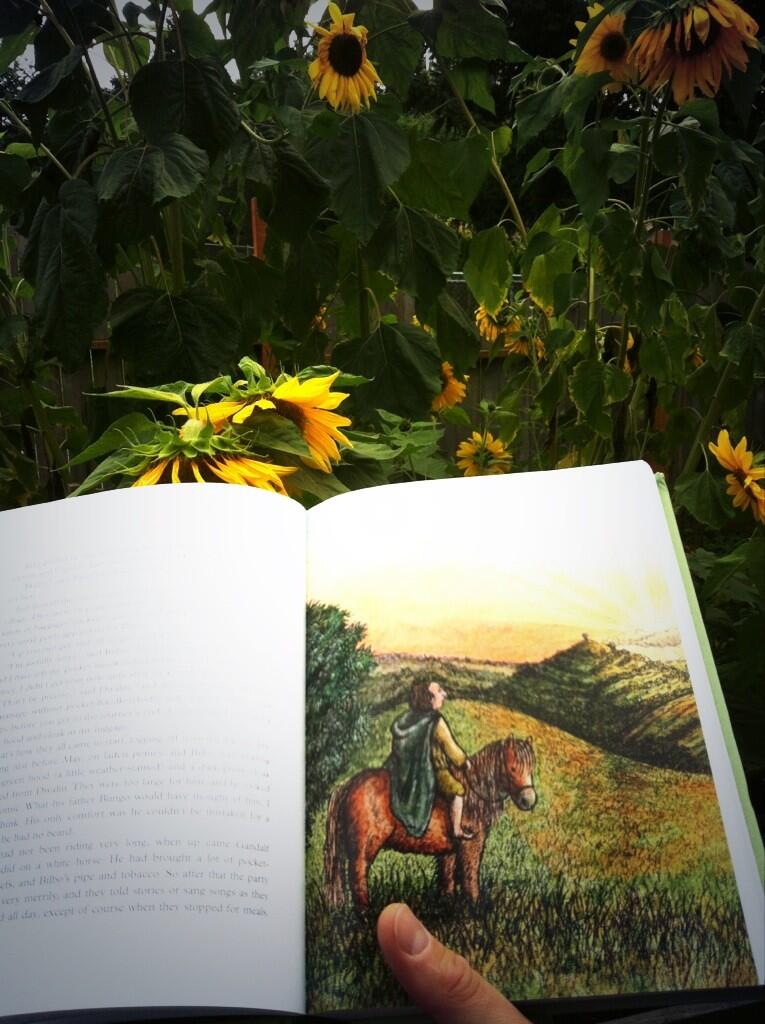
The Wisdom of the Shire Tells Us… “A meal is a sacred thing to be shared in joy and calm and gratitude.”

Rush and Rivendell


Back in the day (and I’m talking about the early eighties) Rush fans like me used to get a lot of crap from rockers about Rush’s song “Rivendell” which was considered to be a very lame tune by people who listened to bands like AC/DC or Ted “Cat Scratch” Nugent. Every Tolkien fan I knew, however, loved “Rivendell.” The boys–Geddy, Neil and Alex–weren’t afraid to let their Middle-earth freak flag fly, and we loved them for it. The song was on the album Fly By Night (1975), which also featured the classic fantasy rock song “By-Tor & the Snow Dog” which my friends and I still belt out in our bad Geddy Lee voices when we’ve had a few pints. It’s been over 35 years since that album came out, and Rush is still going strong. My three childhood buddies, all of whom were Tolkien enthusiasts, are going to see Rush live with me in Seattle this November. And Rush’s new album is an awesome blend of speculative fiction storytelling, genius arrangements, and kick ass musicianship. Rush is an inspiration. They’re doing some of their best work as they’re heading into their sixties. Maybe they’re like long-lived Hobbits and they’ll still be around when they’re in their hundreds, just like Bilbo (who left Rivendell for the last time when he was 131 years old).

We feel the coming of a new day

Darkness gives way to light a new way

Stop here for a while until the world

The world calls you away

Yet you know I’ve had the feeling

Standing with my senses reeling

This is the place to grow old ’til

I reach my final day

–From “Rivendell”